Saturday, September 21, 2013

"B" Beading

Beads and Beading
 Decorative hollowed-out objects have been strung together for at least 5,000 years. Most cultures have used beads made from shell, wood or soft stone for adornment, as good luck talismans, or for religious purposes.

The necklace on the right was created by stringing small turquoise, coral and silver beads on soft silver wire. I crocheted the wire picking up a bead between each stitch. Three crocheted stands were then plaited together. The other necklace used the same technique with jet stones and silver beads.

The availability of a vast variety of beads and beading books for jewelery making abound in crafts stores. You will be tempted to create complex designs. Why not recycle old jewelry by restringing it?


 Applique beading is tedious and requires good eyesight, patience and a magnifying glass. The flower design and the solid white background of this Native Alaskan dance dress was created with seed beads each sewn individually on the yoke of the elk skin dress.
 
Another form of beading uses a loom and is familiar as beaded belts and hat bands seen in Southwest native bead work.
 
Would you have the patience to attempt applique beading?


I embellished this loon wall hanging with seed and bugle beads to enhance the cut out silhouette design. It took a blue ribbon in the Alaskan State Fair.


You can enhance many crafts projects with beading, create distinctive jewelry, and even create your own beads. 

Challenge: Make beads from rolled paper. Cut paper into long tapering triangles. Roll the strip, starting at the wide end of the triangle, around a toothpick. Apply a thin layer of glue to the remaining paper and continue to roll the strip of paper into a cylinder. Remove the toothpick. String the beads.
You could cut large beads from seeds, nuts or twig. Drill holes for stringing.

Writers. Does your character have a favorite necklace, ring, or bracelet? Why?

Websites: beadage.net.       freepatterns.com             auntiesbeads.com

Comments on baskets included many who collect unusual baskets and use them in their homes.
No one reported seeing my mystery basket.


Saturday, September 14, 2013

"B" for basket crafts

Anthropologist disagree whether basket making or pottery developed first. Clay is easier to form into a container than weaving fibers, but ancient fired pottery shards  have been found with the imprint of woven fibers. Which did man create first?  How long ago, in history, was baby Moses hidden from Pharaoh in a water proof basket?   
 
Since we are all familiar with woven Easter baskets, I'll introduce you to birch bark baskets. While in Alaska my friend and I studied native crafts and tried our hand. We collected birch bark that had naturally peeled from the trees, soaked it in water and trimmed the sheet of bark into a usable size. The bark was rolled into a cylinder and held with clothes pins while a bottom of bark was cut to fit. Using an awl, holes were punched into the sides and base. A twig, caning, or jute was added to stabilize the edge while we stitched the bottom and sides together. Traditionally, caribou sinew or spruce roots are used. We didn't have roots or sinew, so we used raffia.
I painted the eagle and loon.


Here is a real challenge. I found this basket made from woven vines and covered with matted fibers in a thrift store. No one knew its history. The horns appear to be cow or buffalo. The strip of fur is not rabbit. The hair is coarse and short like goat. This basket would not hold water but the weave is tight enough to hold tiny items. It is about 18 inches in diameter and 12 inches in height. Why do you think it was created? What is it's use?

Challenge: Use pine needles, or other long plant material (or a sheet of rolled newspaper) Wrap the material with raffia (or yarn). Coil the wrapped fiber into a snake and stitch the coils together to form a flat mat. to make sides on your basket, place the coils on top of the previous row as you progress.

Write a short story that would include the basket pictured.

Websites: Wikipedia.org/wiki/basket_weaving
siziscrafts.com/how-to-make-a-basket
tipjunkie.com/holidaycrafts/easter-basket-'templates/

Comment from K on Art. She said that the art museum in her town had a free night once a week, so she and friends took advantage. The ladies took notes on painting, etc. and compared their thoughts over coffee. Each had discovered ideas to use in crafts.

email comments to grandmas_onthego@yahoo.com
 

Sunday, September 8, 2013

Another "A". ART

 Art is human creative skills that develop in civilizations after the basic need of food, clothing and shelter have been met. Primitive cultures have body art, art on clothing and walls, and jewelry. Infants today are introduced to color, shapes and textures, and are rapidly exposed to public art in the form of posters on the walls in the mall, TV and of course picture books. Do you stop to look at the art work around you?


Drawing a basic form of art used for sketching ideas as well as completed expression. Above is a colored pencil drawing by Doug Lindstrand that I discovered in a small café along the Tok Highway in Alaska. I see expression of the old prospector's character and even the dog's. What do you see?


This oil painting of the interior of an old barn is one that I painted many years ago on site. Realistic paintings as well as abstracts intrigue us. The question arises, "Do you like it? Why or why not?"


Sculpture is three-dimensional art. I have never done very much sculpture. This guy is from my teaching days. I was so blessed to teach art in schools where I had access to a large variety of materials. What other materials could you use beside clay to create sculpture?

Drawing, painting and sculpture are certainly not the only examples of fine art. Many artists express themselves in mixed media using two or many more materials. Crafters may embellish their creations with painted designs or develop a craft form as fine art.

Challenge: Try your hand with an art medium that is unfamiliar to you.
Visit an art museum or studio or children's art festival looking for an "Ah ha, that's what I like" moment. Why do you like it? Be specific.

Response from architecture can be summed up by paraphrasing several commenters who said they discovered "Mc Mansions" that didn't appear to be occupied although the yards had been tended. You wondered who had lived there and why these beautiful homes were vacant.

Websites:  I will list websites as we explore drawing, painting and sculpture in more depth.


Saturday, August 31, 2013

A is for Architecture

Thanks for all the comments on "Animals" as inspiration for writing and crafts. My favorite story is from a lady who was walking through the narrow city streets of Iran when a camel pulled off her head scarf and mouthed her blond hair. Did it think her hair was hay? Camel slobber. Yuck!

Everyone has a shelter to call home, whether an apartment, mobile home, bungalow or mansion. Spooky old houses, tumbled down barns, and ancient construction attract us.  Let's look at a few distinctive homes. How would you like to live here?
Sod roofed cabins are updated homes based on the "soddies", underground cave-like dwellings used by pioneers on the prairies. This cabin sports a sod roof that provides insulation in the Alaskan climate. Upscale pent houses often have roof gardens, and "Green" architects are designing environmentally friendly homes with plantable roofs. How would you like to pick the veggies for dinner from your roof?
 
 
I like to explore older neighborhoods in small towns. Well-kept historical homes with guided tours fascinate me, but I prefer my imagination. How many generations have lived here? Is it still occupied? What secretes could the walls tell? Are there reports of ghosts? Do you wonder how people in other countries developed the style of their homes?


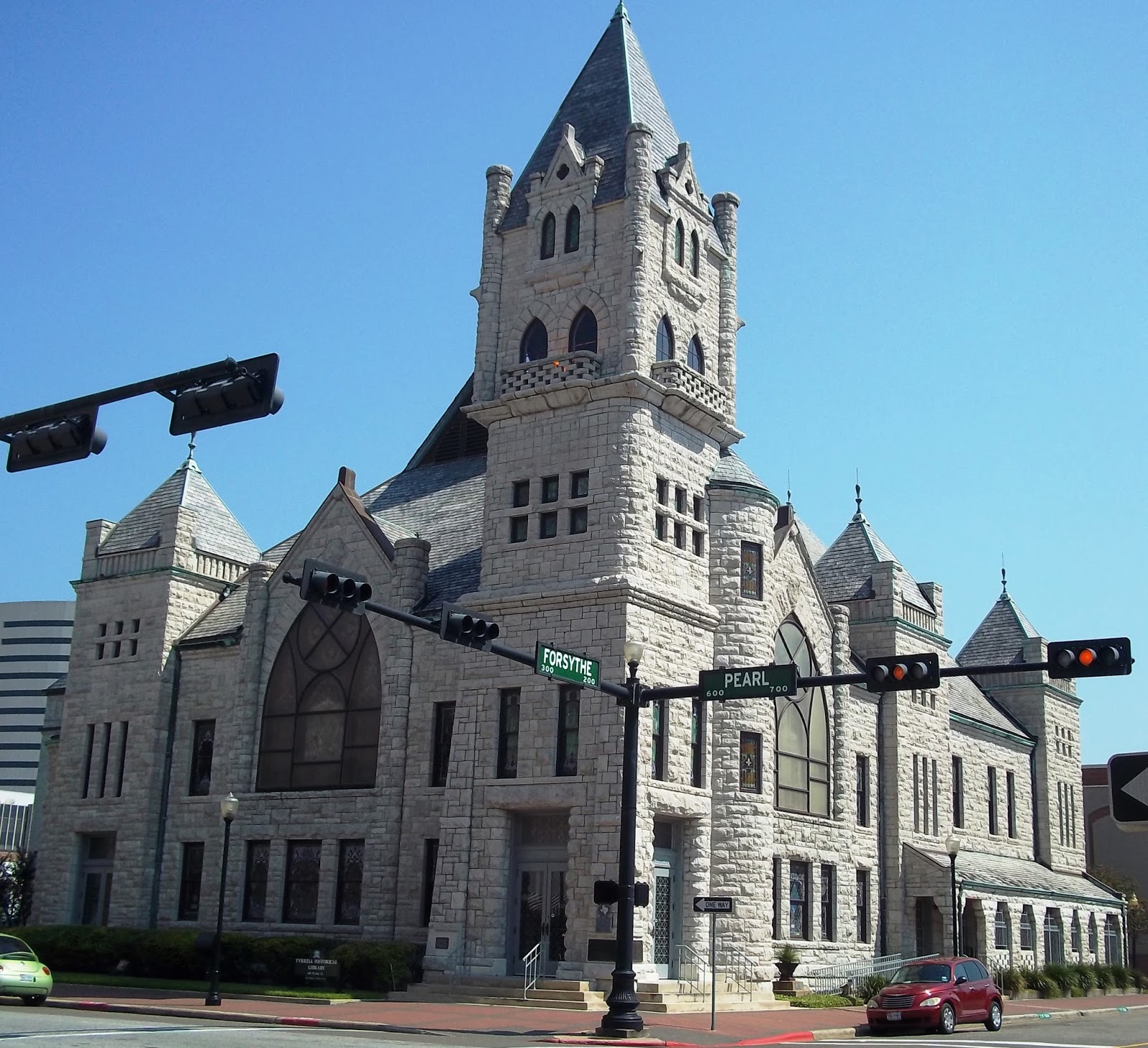
This is one of my favorite buildings. The Gothic castle was built as First Baptist Church of Beaumont, Texas, in 1903.When the church relocated in 1923, Captain Tyrrell bought the building and donated it to the city to be used as a library. As a teen, I rode the city bus to spend hours in the stacks in the rainbow-colored light filtered through the enormous stained glass windows. In 1974 the building was converted to the Tyrrell Historical Library. Renovations and restoration have preserved fond memories of hiding in the dark corners of the children's section and sneaking up the stairs into the bell tower. Yes, there are ghost stories. I'm using the library as a secondary setting a new novel.
 
Challenge: Writers, photograph a house that fascinates you. Create characters to occupy the home, letting the mood and ambiance of the building impact your character(s) in the plot. All story characters have to live somewhere, have a place to work and favorite restaurants. It's up to you to make those places real for your reader.
Challenge: Crafters, design a bird house, playhouse, or outdoor playground around an architectural theme.
 
Websites: architecture.about.com     greatbuildings.com    archeturaldesigns.com 
 
Next time we will explore the vast field of Fine Art.
 

Saturday, August 24, 2013

Dabbling from A to Z

Email response to "Right-brained Dabbler" has confirmed that there are a lot of us who want to know something about everything. Writers commented that they were surprised at how many interests they had beside writing. Craftsmen noted that they could now see ways to combine interests into a new creation.

Using my list of interests we're going to explore Dabble topics beginning with A for Animals.

 
Your interest may be in domestic pets or in wild animals. Or both. Animals are excellent topics for stand-alone stories (especially for children), or as inclusions in fiction. I photographed this moose, "praying for spring", through a window. Female moose protecting a calf or two are one of the most dangerous animals in the wild. The ungainly, roman-nosed ugly moose is a favorite for craftsmen to characterize.


Another wild animal that is best studied from a distance, the black bear, has influenced writers to create Yogi the Bear, Smokie the Bear and that cute mama and baby bear for Charmin tissue.
We are all familiar with the Teddy Bear and all of his adorable offspring.

 
I suggested that you list what you did NOT like. Snakes top my do not like list. I forced myself to touch this one and was surprised that its scales are dry and slick. I have to admit that the pattern and colors are lovely. If I were to write about a snake in a story, it would be from the view point of dislike.
 
Challenge: Tiny Prince George has a nursery with an African wild animal theme. Do you think the theme will become a trend(long term) or a fad (quickly fading)? 

Craftsmen: Design a toy or clothing with an African animal theme.
Writers: Write a children's story that you might submit to Kate and William as a gift for George.
 
Websites: rainforestanimals.net           news-nationalgeographic.com
 
Next time we will discuss architecture.
 
To order Dare to Dabble email grandmas_onthego @yahoo.com


Saturday, August 17, 2013

Right-brained Dabbler

I was probably ADHD before that diagnosis became popular. I drove my parents and teachers nuts as I flitted from one interest, idea and project to another. Right-brained people enjoy challenges, are creative and are constantly wanting to try something different.

Writers, you've heard the adage "write what you know". How do you know what you know? Neither you nor I can afford a team of researchers so by identifying your interests, talents and abilities you will be able to write with authority.

Crafters, you will learn a lot about yourself and how you can put your creativity to work for you.

I'm going to share activities to get you started. You may use electronic gadgets, smart phone, digital camera, electronic notepad, etc. but since writers/craftsmen are visual learners transfer electronic notes to paper.

Using a roll of calculator tape begin to list everything that interests you, every activity you've been engaged in or would like to explore. This may get unexpectedly long....... Hang it up proudly.

Don't have calculator tape? On a sheet of lined paper, draw a vertical line down the center to create two columns. At the top of the first column write "Interests". At the top of the second column write "Talent/Ability" (something you could teach). List, list, list. Don't try to analyze your topics, just write. Later use colored markers or pencils to color code related topics. These are your specialties.

Sticky Notes are a valuable tool for jogging your experiences from memory. Carry a notepad and pen as you do chores, at your job, in the car. Jot dot down your interests with a star to indicate a special ability. Use a spiral notebook to organize your notes into topics that express you.
 
These activities will empower you. You are creative. You have an active brain. What if you don't finish what you start?  But you have finished when you've gotten what you wanted out of the activity; there doesn't have to be an end product. Give yourself permission to put a project aside and try something else. 
 
 As a writer, don't guess. Write what you know. I recently read a well know author who talked about a male cat that was white with brown and gray spots. WRONG. Three colored cats are calicos and are 99.9% female.
 
Craftsmen do you now see how you could combine two or more of your interests into something unique? Think of combining patchwork quilting with beadwork and three dimensional flowers.
 
Challenge: Make a list of what you don't like, what you wouldn't like to try and why.
                  Make a bucket list of things you'd like to do before you die, and research the reality of actually doing at least one of these.
 
Next time we will begin exploring my interests from A to Z.
 
Websites: dailywritingtips.com          artsandcrafts.about.com
 
Dare to Dabble is available at grandmas_onthego@yahoo.com


Saturday, August 10, 2013

Dare to Dabble. Are you a Dabbler?

          I'm not just a writer, I'm a Jill of all trades and master of few. I'm a Dabbler and proud of it. God gave me a gift of creativity; I like to plan and create, but when I see the end I'm through, finished, the challenge is gone. Then I'm ready to do something else. Slap my hands? I don't think so. I was 60+ before I realized that Dabbling is okay for me and you.

Do you have a story to tell and don't know where to start?
Do you approach creative writing or crafts projects with enthusiasm and then lose interest?
Are you curious about everything and wonder how to fit it all in?
Do you wonder how to keep your passion for writing/creating burning?
Do you need methods to unblock writer's Block?

If your answer is yes to any of the above, you are a Dabbler!!   I'm presenting free information for you from my new book.


Webster states that to "dabble" means to play, especially with the hands, to work at anything in a superficial manner. It also means to experiment, or tryout. I try my hand at a number of crafts projects as well as writing. I don't waste too much time or dawdle. I'm constantly learning. What I learn enhances my writing and is a lot of fun.
 
Without getting technical, here is the plan for future blogs on Dabbling.
 
1. I will present a Dabbling theme, like quilting or basket making, or writing memoirs and give a brief personal story.
 
2. Websites for the Dabble theme will be listed for additional information.
 
2.I'll present a challenge to try this craft (or idea) and prompts to include it in your writing.
 
3. Finally, I'm asking for a short comment (100 words or less) on your experience with this topic (tips, innovative twist or techniques) One or more of these will be posted on the next blog.
 
Join the fun next time as we explore brain activities to assess what you know and have a passion for.  
 
For a copy of "Dare to Dabble" email be at grandmas_onthego@yahoo.com ($10 US)